Telescope Mirror Coating & Recoating
Optic Wave Laboratories runs its own vacuum coating facility and offers it to the public. We coat and recoat telescope mirrors up to 22 inches in standard aluminum, semi-enhanced aluminum, enhanced 96% aluminum, protected silver and gold — new optics and existing mirrors alike.
Reopening January 2027. Optical coatings are the first service returning in our new facility. We are not taking orders yet. The prices below are current and apply to work booked for the reopening.
Coatings we offer
Five coatings, all applied by ion assisted deposition in our own chamber. Which one is right for you depends on how much light you want back and what you are willing to spend to get it.
| Coating | Measured average | Peak | Overcoat | Best for |
|---|---|---|---|---|
| Standard protected aluminum — 89% | 90.22% | 90.56% | Yes | General purpose recoating |
| Semi-enhanced aluminum — 92% | 91.45% | 92.53% | Yes | A visible gain for a modest step |
| Enhanced aluminum — 96% | not yet published | — | Yes | Imaging, and multi-mirror systems |
| Protected silver — 97% | 93.47% | 97.05% | Yes, always | Scientific and infrared work |
| Gold | — | — | Optional | Infrared and laser applications |
Standard protected aluminum — 89%
Our baseline coating and the right answer for most recoats. It is specified at 89% and measures 90.22% average across the visual band with a 90.56% peak — we publish the figure we measured, not the figure we sell it under. Like all our aluminum coatings it carries a protective overcoat, so a protected aluminum mirror can be cleaned carefully without lifting the film.
Semi-enhanced aluminum — 92%
A multi-layer stack. The 92% in the name is its peak, near 500 nm; the visual-band average is 91.45%. That distinction matters when you are comparing coatings, because a headline number is usually a peak and an average is usually lower. A modest step in cost for a gain you can see.
Enhanced aluminum — 96%
Our high-reflectivity enhanced aluminum coating, and the usual choice for imaging or for a multi-mirror system where every surface costs you light. Two surfaces at 96% return 92% of the light; the same two at 89% return 79%. It is not yet in our published measurement set — it will be included when we re-measure the full range in the new facility, and we would rather say so than quote a number we have not taken ourselves.
Protected silver — 97%
The brightest coating we run, peaking at 97.05% and holding above 96% from roughly 550 nm into the near infrared. Always overcoated, because bare silver tarnishes. A protected silver mirror is a specialist choice for scientific and infrared work rather than a general upgrade — even overcoated it is less durable than aluminum, so for a telescope in ordinary use we would steer you to one of the aluminum coatings.
Gold
For infrared and laser work. Gold reflects poorly in the blue and green, so a telescope mirror coated in gold looks dim and color-shifted to the eye. Supplied overcoated or bare depending on your application.
Recoating an existing mirror means stripping the old film first; that is priced separately below. We also coat new optics straight from the polisher.
Our coating process

The heart of the system is a multi-pocket electron beam source assisted by a Veeco ion source, giving us ion beam assisted deposition for superior adhesion and brightness.
Glow discharge plasma cleaning
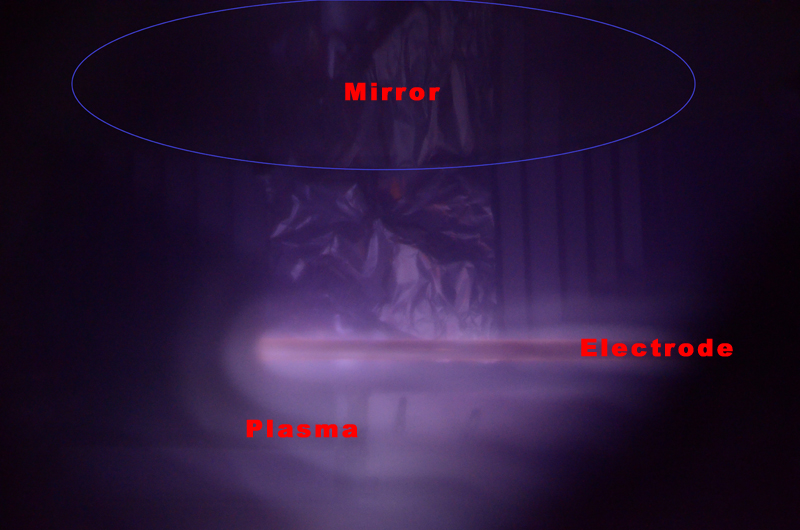
Before any coating is applied, during the initial chamber pump-down, we run a glow discharge plasma cleaning cycle. Modulated high voltage excites the residual atmosphere into a high energy plasma. That plasma scrubs the surface to be coated, lifting hydrocarbons, water and residual gas molecules off it, and scrubs the inside of the chamber at the same time — which also gets us a harder vacuum. A cleaner surface and a better vacuum produce a brighter, better adhering and more stable coating.
Ion assisted deposition
As the coating goes down, the Veeco ion source ionizes argon atoms and accelerates them into the deposition cloud. That energy transfers to the coating material and drives it into the surface, which is what makes the film adhere and stay stable.
Automated control
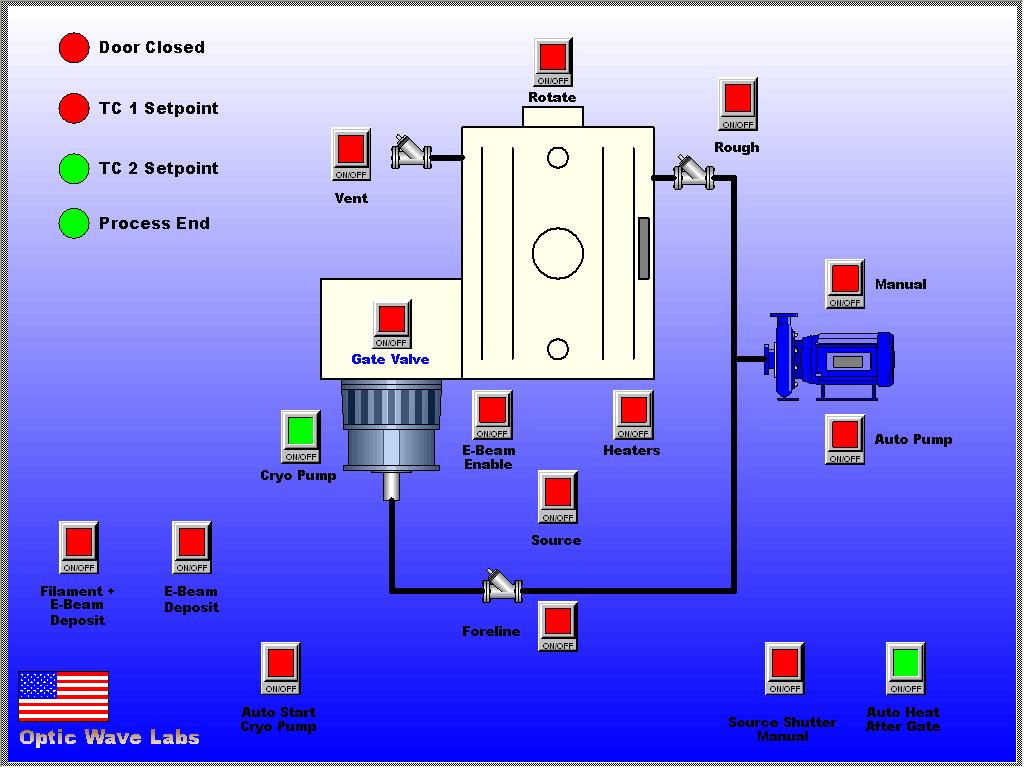
Deposition is monitored and adjusted in real time by a high speed deposition controller, and the whole system runs under PLC control — pumping, substrate heating, substrate rotation and the deposition cycle itself. The coating run is executed the same way every time, which takes operator variability out of the result.
Coating prices
These are our current list prices, published August 2026 and effective for work booked for our January 2027 reopening. A quote is held at the price shown when it is issued.
Primary mirror coating
| Size (inches) | Standard 89% | Semi-Enhanced 92% | Enhanced 96% | Silver 97% specialist use | Gold specialist use |
|---|---|---|---|---|---|
| 6 and under | $123.00 | $135.00 | $147.00 | $169.00 | $900.00 |
| 7 | $140.00 | $154.00 | $168.00 | $193.00 | $900.00 |
| 8 | $160.00 | $176.00 | $192.00 | $221.00 | $900.00 |
| 10 | $208.00 | $229.00 | $250.00 | $287.00 | $900.00 |
| 11 | $236.00 | $260.00 | $284.00 | $326.00 | $905.00 |
| 12 | $267.00 | $294.00 | $321.00 | $369.00 | $911.00 |
| 12.5 | $284.00 | $312.00 | $340.00 | $391.00 | $915.00 |
| 13.1 | $304.00 | $335.00 | $365.00 | $420.00 | $920.00 |
| 14 | $337.00 | $370.00 | $404.00 | $465.00 | $930.00 |
| 15 | $376.00 | $413.00 | $451.00 | $518.00 | $942.00 |
| 16 | $417.00 | $459.00 | $500.00 | $576.00 | $956.00 |
| 17.5 | $484.00 | $533.00 | $581.00 | $668.00 | $981.00 |
| 18 | $508.00 | $559.00 | $610.00 | $701.00 | $990.00 |
| 20 | $610.00 | $671.00 | $732.00 | $841.00 | $1,033.00 |
| 22 | $722.00 | $794.00 | $867.00 | $997.00 | $1,084.00 |
Not for ordinary telescope mirrors
- Silver 97% — A specialist coating for scientific and infrared work. Silver has the highest visible reflectance we offer, but it tarnishes and is far less durable than aluminum even with an overcoat. It is not what we recommend for a telescope mirror in ordinary use.
- Gold — A specialist coating for infrared and laser applications. Gold reflects poorly across the blue and green part of the visible spectrum, so a telescope mirror coated in gold will look dim and color-shifted. Choose it only if your application needs infrared performance.
Additional services
| Service | Price |
|---|---|
| Coat secondary or diagonal with the primary | $35.00 |
| Strip existing coating | $15.00 |
| Clean dirty or painted optics | $15.00 |
| Remove mirror from cell or holder | $10.00 each |
| Re-install mirror in cell or holder | $40.00 each |
| Center spot with collimation triangle | $15.00 |
| Free optical test | $0.00 adds up to 2 weeks |
| Packing | $10.00 per box |
| Return shipping | On request quoted at current carrier rates |
- Prices are list price. Any sale or discount is subtracted from these figures.
- All aluminum and silver coatings have a protective overcoat.
- Gold coatings may be overcoated or left bare depending on your application.
- Optical coatings are warranted against defects for 30 days from the date of the original invoice.
- Return shipping, packaging, stripping and center spotting are charged at full price.
Price list effective 2026-08-13.
Measured reflectivity
We publish the actual measured spectra for our coatings rather than manufacturer claims — curves, averages, wavelength-by-wavelength figures and the raw data file. To our knowledge no other coating service does this.
| Coating | Visual average (420–650 nm) | Peak |
|---|---|---|
| Standard aluminum | 90.22% | 90.56% |
| Semi-enhanced aluminum | 91.45% | 92.53% |
| Protected silver | 93.47% | 97.05% |
Our enhanced 96% coating is not yet in the published measurement set. It will be included when we re-measure the full range in the new facility.
Packing and shipping your mirror
Most coating damage we see arrives in the box, not in the chamber. We have filmed how we want a mirror wrapped and boxed — following it costs you nothing and protects the optic in transit.
Watch the packing and shipping videos, or read our customer education pages for mirror cleaning and diagonal sizing as well.
Frequently asked questions
What does it cost to recoat a telescope mirror?
Recoating a 10-inch primary is $208.00 in standard aluminum, $229.00 semi-enhanced and $250.00 enhanced. Every size and coating we offer is listed in the price table on this page.
What is the largest mirror you can coat?
Our automated deposition system accommodates telescope mirrors up to 22 inches in diameter.
What is the difference between standard, semi-enhanced and enhanced aluminum?
They differ in how much light they return. Standard aluminum averages about 90% across the visual band and peaks at 90.56%. Semi-enhanced averages about 91.5% and peaks at 92.53%. Enhanced aluminum is our 96% coating. Protected silver is the brightest at a 97.05% peak. Our measured curves and the underlying spectra are published on the coating data page.
Is telescope mirror aluminizing the same thing as recoating?
Yes. Aluminizing, coating and recoating all describe the same job: depositing a new reflective film on the optical surface. We strip the old film first, then coat.
Do you strip the old coating before recoating?
Yes. Stripping an existing coating is $15.00 and is added to the coating price.
Can you coat my secondary or diagonal at the same time?
Yes. A secondary sent in with its primary is $35.00.
Is the coating protected with an overcoat?
All of our aluminum and silver coatings carry a protective overcoat. Gold can be overcoated or left bare depending on your application.
What is ion assisted deposition, and why does it matter?
A Veeco ion source ionizes argon and accelerates it into the deposition cloud, driving the coating material into the surface with more energy than evaporation alone. Combined with a glow discharge plasma clean before deposition, it produces a brighter, better adhering and more stable coating.
Can you recoat an old reflecting telescope mirror?
Yes, and age on its own is not a problem. We strip whatever is left of the old film, clean the bare glass and coat it fresh, so a mirror from the 1970s finishes in the same condition as a new one. What age does affect is the glass underneath: decades of cleaning can leave fine sleeks and pinholes that a new coating will not hide. We will tell you what we find before we coat it, and if the surface needs work, refiguring is a separate service.
What is a protected aluminum mirror?
Aluminum by itself oxidizes within hours and is soft enough to scratch under a cloth. A protected aluminum coating adds a hard transparent overcoat on top of the metal, which stops the oxidation and lets the surface be cleaned carefully without lifting the film. Every aluminum and silver coating we apply is protected as standard.
How long does a telescope mirror coating last?
A protected aluminum coating in normal amateur use commonly lasts ten to twenty years. What ends it is rarely the coating itself but the environment: coastal salt air, damp storage and repeated aggressive cleaning all shorten its life considerably, while a mirror kept dry and covered can go far longer. Recoat when reflectivity has visibly fallen or the overcoat shows pinholes and patches, not on a schedule.
Do you coat optics other than telescope mirrors?
Yes. Alongside amateur telescope work we run contract optical coating for commercial and scientific customers on first-surface mirrors and other optics up to 22 inches. Tell us the substrate, the size and the reflectance you need and we will quote it.